
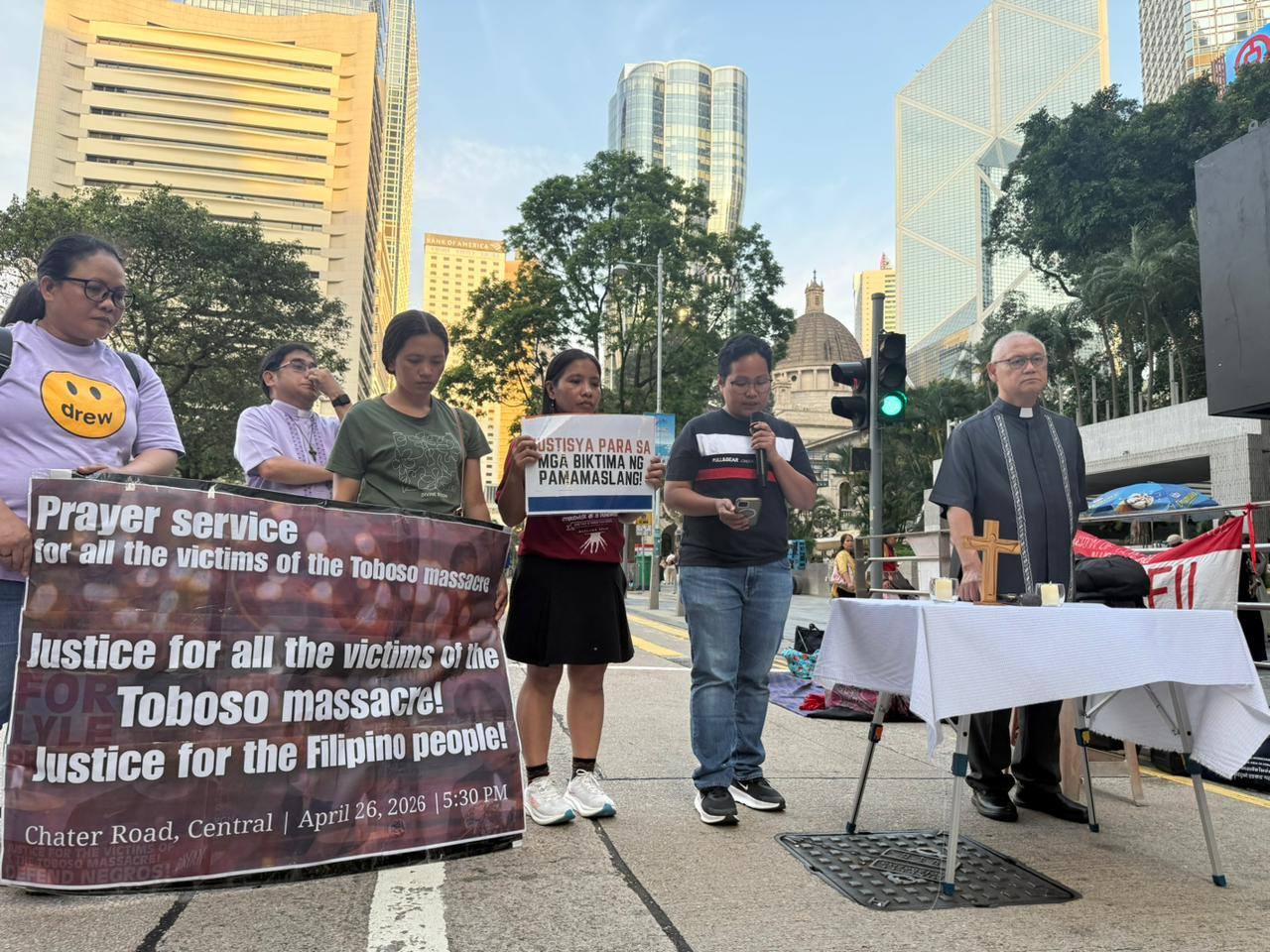
📷: Filipino migrant workers and human rights advocates in Hong Kong gather at Chater Road, Central, for a prayer vigil and to lay flowers in memory of the victims of the Toboso Massacre, attributed to the AFP. (Courtesy of Karapatan)
by Diego Morra
The military spin on the so-called encounters in Toboso, Negros Occidental that led to the killing of 19 people, two of them Americans, two University of the Philippines (UP) students, an Altermidya journalist, a cultural worker, a farmer working on his uncle’s business and 12 others has become Swiss cheese, dotted with holes that cannot be filled the with the asphalt supplied by the National Task Force to End Local Communist Armed Conflict (NTF-ELCAC.)
First, the purported clashes spanned two days, from April 19 to 20, with gunfights lasting 12 hours. The yarn was that it was a big clash in one barangay, only to be amended to mean continuous clashes in remote sitios. The military then barred an investigation into the incident, arguing that pursuit operations were still being conducted. Then, photos were shown about the firearms seized, the first featuring only seven weapons, later expanding to 9 and then 20. Residents later confirmed that UP student Alyssa Alano and Altermidya journalist RJ Nichole Ledesma were shot dead in a Sitio Plarinding, three kilometers away from the scene of the encounter at Sitio Sinugmawan.
By controlling the scene of the massacre, the military had all the time to weave what could have been a plausible story. They can recycle so-called “evidence,” like the walking skeletons of Leyte and the handguns with the same serial numbers that were used as “evidence” in at least three criminal cases. To reduce the possibility that people residing in the vicinity might debunk their story, the military caused the evacuation of 653 people from 168 households. Yet, the truth will eventually be uncovered as witnesses said huts were surrounded by soldiers and subjected to intense automatic gunfire.
In all probability, Maureen Keil Santuyo of the National Network of Agrarian Reform Advocates Youth (NNARA-Youth) and UP Open University (UPOU) and Errol Wendel of the Unyon ng Manggagawa sa Agrikultura (UMA), both 24, could have also been gunned down in the same sitio as both of them have been working with Negros peasants and farm workers who oppose the establishment of a Consunji-backed oil palm plantations in Candoni town, as well as quarrying in environmentally-threatened areas. The Consunjis were linked to the massacre of T’boli and Manobo corn farmers in Lake Sebu, South Cotabato who opposed their coffee plantations and prospecting for minerals several years ago.
Like RJ Ledesma and Alyssa Alano, they were in Negros to stand with farmers, to learn from them, and to help amplify their struggle for land and justice. Ledesma, a writer of Paghimutad and coordinator of Halungan Aton Kadanyagan sa Occidental kag Oriental Negros (HAKSON), was investigating how big-ticket energy and agribusiness projects — palm oil in Candoni, solar farms and other so-called renewable ventures across Negros — were dispossessing farmers and destroying the environment. To belie the military claim that all 19 fatalities were combatants, the New People’s Army (NPA) in Negros Island said only three NPA fighters led by Roger Fabillar were at the encounter site.
The Toboso massacre is significant since it is the first time in the country’s history that two foreign human rights advocates have been killed in an encirclement and suppression campaign by the Philippine Army (PA) and its paramilitary forces. The two—Fil-American Lyle Prijoles and Kai Sorem — had long supported the campaign in US Congress to significantly cut military aid to the Philippines owing to extrajudicial killings, enforced disappearances and massive displacement of rural communities following the imposition of Memorandum Circular No. 32 (MC 32) by then president Rodrigo Duterte in 2018. Scores have been killed in Negros Island because of joint military and police operations, with the Sagay 9 massacre as a prime example of the culture of impunity trashing the rule of law and Philippine obligations under international humanitarian law. The Toboso 19 massacre is but a repeat of the Escalante massacre during the dark days of the Marcos Sr. fascist dictatorship.
Curiously, the massacre happened after national security adviser Eduardo Ano quit his post, ostensibly after failing to defeat the revolutionary movement as he had promised. Ano, who had been suspected of having a hand in the disappearance of activist Jonas Burgos 19 years ago, was also associated with Maj. Gen. Jovito Palparan, who was convicted for the disappearance of UP students Karen Empeno and Sherlyn Cadapan. It now appears that militarist factions in the regime want a “no quarter” policy consistent with the US Counterinsurgency (Coin) Guide. This means no prisoners are taken and anyone in the “conflict zones” is fair game, with the remains of the fatalities mutilated, their faces unrecognizable.
Concerned about the gravity of the Toboso 19 massacre, the Commission on Human Rights (CHR) has said it will conduct an independent inquiry into the massacre as what the National Democratic Front of the Philippines (NDFP) has demanded, along with the Malaya Movement in the US which mourned the demise of Lyle Prijoles and Kai Sorem, the Philippine Ecumenical Peace Platform (PEPP), the University of the Philippines-Visayas and hundreds of organizations in UP’s constituent universities as quell as ROTC cadets who threatened to boycott their training as the Department of Military Science and Tactics (DMST) kept mum on the massacre. Protest actions have been launched to denounce the Toboso 19 massacre in UP Diliman and various colleges and universities nationwide. #